Please wait…
PhysioEverywhere
Personalised rehab and preventive care — at your pace, in your space.

PhysioEverywhere Learning

Spine, trunk &
peripheral nerve
anatomy.

Understand the structures. Explore the connections. A detailed learning pathway through the spine, muscles and peripheral nerves.

For physiotherapy students and clinicians.
A clear starting point for anyone interested in anatomy.

Build your understanding

From structure
to connection.

  1. FoundationsFind your bearings
  2. RegionsCompare the spine
  3. MusclesConnect with movement
  4. NervesFollow the pathways
View illustration
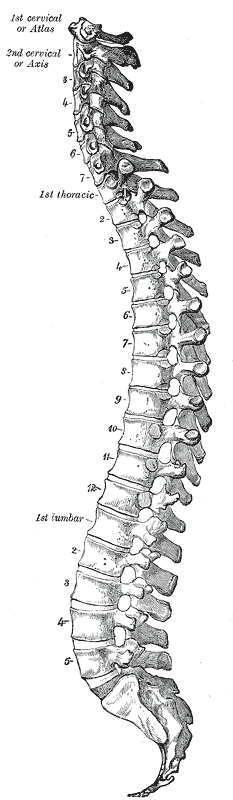
Historical lateral view of the vertebral column, from the cervical vertebrae to the sacrum and coccyx, from Gray's Anatomy, 1918.
Historical overview illustration. Image source and public-domain credit are given in the Sources section.
Your learning pathway

Choose a chapter

Begin with the foundations, or find the region, muscle group or nerve pathway you want to explore.

8 chapters · 1 available
FoundationsChapter 1

Orientation to the vertebral column

Find your bearings: the regions, curves and language that underpin the study of the spine.

View chapter outline: Orientation to the vertebral column

In this chapter

  • Vertebral regions and their arrangement
  • Spinal curves and posture
  • Functions of the vertebral column
  • Anatomical directions and terminology
  • Surface landmarks and introductory palpation

Learning objective

Describe the organisation of the vertebral column and use anatomical terminology consistently.

The full chapter includes an anatomical illustration, interactive region explorer and revision questions.

FoundationsChapter 2

Understanding a vertebra

Explore the components of a typical vertebra and the features that distinguish each spinal region.

View chapter contents: Understanding a vertebra

Chapter content

  • Vertebral body and arch
  • Pedicles and laminae
  • Spinous, transverse and articular processes
  • Vertebral and intervertebral foramina
  • Regional comparison and identification

Learning objective

Identify the principal vertebral structures and compare their appearance across regions.

The full lesson includes four labelled textbook illustrations, identification activities and 25 revision questions.

FoundationsChapter 3

Discs, joints & ligaments

Connect the structures between neighbouring vertebrae with their roles in spinal movement.

View chapter contents: Discs, joints & ligaments

Chapter content

  • Intervertebral disc structure
  • Nucleus pulposus, annulus fibrosus and endplates
  • Facet joint anatomy
  • Principal spinal ligaments
  • Regional movement comparisons

Learning objective

Explain how discs, joints and ligaments contribute to the organisation and movement of the spine.

Explore discs, facets and ligament attachments with interactive activities and 25 revision questions.

RegionsChapter 4

The cervical spine

Study the neck, with dedicated attention to the atlas, axis and upper cervical joints.

In preparation
View chapter outline: The cervical spine

Planned content

  • Typical and distinctive cervical features
  • Atlas and axis
  • Atlanto-occipital joints
  • Atlanto-axial joints and associated ligaments
  • Upper cervical movement and review

Learning objective

Distinguish the main cervical structures and describe their anatomical relationships.

The full lesson will appear here when it is ready.

RegionsChapter 5

Thoracic, lumbar & sacral anatomy

Compare the distinctive features of the mid-back, lower back and sacrum.

In preparation
View chapter outline: Thoracic, lumbar & sacral anatomy

Planned content

  • Thoracic vertebral features
  • Rib articulations and the thoracic region
  • Lumbar vertebral features
  • Sacral anatomy
  • Regional landmarks and movement comparisons

Learning objective

Recognise thoracic, lumbar and sacral features and compare the organisation of these regions.

The full lesson will appear here when it is ready.

MusclesChapter 6

Trunk & neck muscles

Bring attachments, nerve supply, muscle layers and movement together in a consistent reference.

In preparation
View chapter outline: Trunk & neck muscles

Planned content

  • Abdominal wall muscles
  • Intrinsic back muscles
  • Neck muscle groups
  • Origins, insertions, actions and innervation
  • Thoracolumbar fascia and regional relationships

Learning objective

Relate muscle attachments and anatomical position to the movements described in each lesson.

The full lesson will appear here when it is ready.

NervesChapter 7

Peripheral nerves of the upper limb

Follow the major upper limb nerves through their course, branches and distributions.

In preparation
View chapter outline: Peripheral nerves of the upper limb

Planned content

  • Axillary and musculocutaneous nerves
  • Radial nerve and its branches
  • Median and ulnar nerves
  • Motor and sensory distributions
  • Anatomy-based comparison and review

Learning objective

Compare the principal upper limb nerves using their course, motor supply and sensory distribution.

The full lesson will appear here when it is ready.

NervesChapter 8

Plexuses & nerves of the lower limb

Connect the lumbar and sacral plexuses with the major nerve pathways of the lower limb.

In preparation
View chapter outline: Plexuses & nerves of the lower limb

Planned content

  • Lumbar and sacral plexuses
  • Femoral and sciatic nerves
  • Tibial nerve and plantar branches
  • Common fibular nerve and its branches
  • Motor and sensory patterns, with review

Learning objective

Trace the principal lower limb pathways and organise their motor and sensory information accurately.

The full lesson will appear here when it is ready.

Make the resource work for you

A clear route through the detail.

This contents page maps out the learning resource. Read the first three chapters, browse the topics and open an outline to see what later lessons will cover.

Follow a pathway

Start with orientation, then move through vertebral structures, discs and joints before exploring the regional anatomy.

Look up a topic

Use the search and topic filters to find the chapter that includes the structure or anatomical relationship you want to study.

Explore the outline

Expand a chapter to see its planned content and learning objective. Chapters 1–3 are linked above; later lessons will follow as they are completed.

New to spinal anatomy?The Foundations chapters are the intended starting point.

Explore the starting point
A transparent approach

Anatomy with context.

This resource is being developed from detailed anatomy study notes. Each completed chapter will bring its explanations, relevant illustrations, learning activities and references together.

The outline is a guide to the planned material. Chapter-specific references will accompany the lessons as they are published.

About the overview illustration

The historical lateral view of the vertebral column is from Anatomy of the Human Body, 20th edition (1918), plate 111, illustrated by Henry Vandyke Carter.

The image is reproduced unaltered as a public-domain overview illustration. It is separate from the detailed teaching figures being selected for the chapters.

Developed by Charis Pafitis for PhysioEverywhere.

Back to top

Vertebral column: historical lateral view

Gray’s Anatomy (1918), plate 111, illustrated by Henry Vandyke Carter. Public domain. Original image: 233 × 800 pixels. Source and credit.